Short answer: Pharma advertising for prescription drugs must give a fair balance of benefits and risks. In a banner, that means the drug name, what it treats and its key risks all sit inside the ad, usually in a scrolling ISI panel, with a link to the full Prescribing Information. Since September 2025 the FDA has been enforcing these rules much harder, so build for review from the first sketch.
This guide is for brand marketers, agency producers and ad ops teams who make or traffic pharma banner ads. It covers the rules that shape pharmaceutical advertising online and what changed in 2025. It also walks through real examples of what works and what doesn’t, and shows how to build a scrolling ISI that gets through MLR review on time.
- What is pharma advertising?
- The rules behind every pharma banner ad
- What changed in pharmaceutical advertising in 2025
- Pharma banner ads: dos and don’ts at a glance
- Pharmaceutical advertising examples: what to avoid
- Pharmaceutical advertising examples: what to copy
- How to build a scrolling ISI in an HTML5 banner
- Pharma digital ads by channel
- MLR review checklist: keep pharma ads on schedule
- A branded ad that says what the drug treats needs risk information inside the ad, not only behind a link.
- Risk copy needs prominence and readability comparable to the benefit claims.
- Reminder ads (name only) are not allowed for drugs with a boxed warning.
- The FDA sent thousands of letters to drug companies in September 2025 and now scans ads with AI tools.
- The best pharma ads are clear first and clever second.
- The static backup is an ad too. It needs the safety copy and an MLR sign-off.
 Stop screenshotting banners by hand.
One ZIP in. Every deliverable out.
Try the free banner tool. No sign-up.
JPGGIFMP4
Try it free
What is pharma advertising?
Pharma advertising is paid promotion for a medicine or for the condition it treats. This guide focuses on US prescription drugs, where the FDA regulates ads under 21 CFR 202.1.
Pharma ads speak to two audiences. Direct-to-consumer (DTC) ads reach patients and caregivers. HCP ads reach doctors, nurses and pharmacists. The same regulation covers both, but the copy, the sites and the landing pages differ.
Before any design work, agree which type of ad you are making. The type decides what the banner may say and how much safety copy it carries.
| Ad type | What it shows | Risk information in the ad | Watch out for |
|---|---|---|---|
| Branded (product claim) | Drug name and what it treats | Required | Fair balance applies to the whole ad, every frame |
| Reminder | Drug name only, no indication or dosage | Exempt | Not allowed for drugs with a boxed warning |
| Unbranded (disease awareness) | The condition, no drug name | Team decision | Keep it clearly separate from branded creative; regulatory sets the rules |
The rules behind every pharma banner ad
The regulation asks every prescription drug ad, apart from the exempt types, to give a true statement of side effects, contraindications and effectiveness. It must also present a fair balance between benefit and risk. Four rules shape a banner most.
- Fair balance. Risk information must be comparable in depth and detail to the benefit claims.
- Comparable prominence. The regulation judges risk copy against benefit copy on typography, layout, contrast, headlines and white space. In a banner, that means font size, color contrast and screen time.
- The established name. The generic name travels with the brand name. Where the brand name runs larger, the generic name appears at least once in type at least half as large.
- Reminder limits. A name-only reminder ad skips the risk copy. It is not permitted when the drug’s labeling has a boxed warning.
Banners don’t get a small-format pass. FDA’s 2014 draft guidance on platforms with character space limitations covers tweets and sponsored search links. It says a firm that presents benefit information there should present risk information too. The notice leaves out online web banners on purpose, because FDA believes they don’t impose the same space limits.
A banner is not a tweet. FDA doesn’t treat web banners as space-limited, so the normal rules apply in full. If the banner makes a benefit claim, the risk information belongs inside the banner. The link to full Prescribing Information comes on top, not instead.
In the industry, the in-ad risk block is called the ISI (Important Safety Information). Our guide to pharma banner best practices and ISI rules goes deeper on layout.
What changed in pharmaceutical advertising in 2025
On September 9, 2025, the FDA announced a crackdown on deceptive drug advertising. It said it was sending thousands of letters to drug companies and about 100 cease-and-desist letters. It also began rulemaking to close the 1997 “adequate provision” loophole, which it says companies use to hide safety risks in broadcast and digital ads.
Two parts of that announcement matter for display teams:
- The FDA said it is already using AI and other tech tools to watch and review drug ads. Low-reach placements are no longer invisible.
- The HHS fact sheet extends oversight to social media promotion. That includes influencer partnerships, sponsored content and algorithm-driven targeted ads.
Rulemaking takes time, and its final shape may change. Ask your regulatory team where it stands before you plan a 2026 campaign. The safe working assumption is simple: every digital placement can be reviewed.
Pharma banner ads: dos and don’ts at a glance
These come from the examples below and from what our designers see in review rounds.
| Do | Don’t |
|---|---|
| Name the condition or audience in the first frame | Hide the indication until the last frame’s small print |
| Show the ISI from the first frame | Fade the risk copy in after the benefit has played out |
| Set risk copy at a readable size and contrast | Shrink the ISI until it’s grey texture |
| Use images that carry the message | Use stock moods that could sell anything |
| Send the click to the page the ad promised | Land people on a generic page with no next step |
| Keep one message and one call to action | Stack claims, offers and links in one 300×250 |
Pharmaceutical advertising examples: what to avoid
These are live campaigns from a few years back. The media has changed. The lessons haven’t.
Don’t trade clarity for cleverness. This Descovy banner opened with four lifestyle frames built around the line “Love what’s inside.” From those frames alone, it could be about suicide awareness, gut health or HIV. Only the small print on the fifth frame reveals it is an HIV-1 medicine.
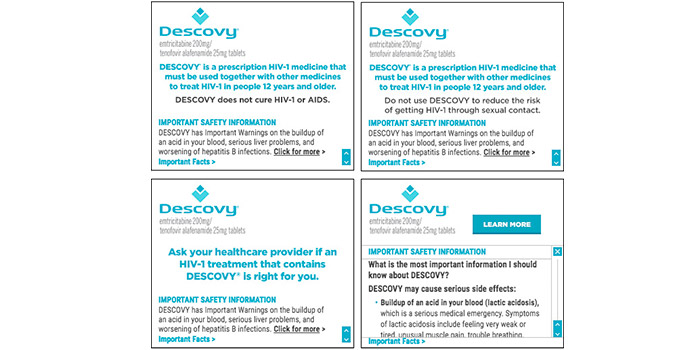
Wit is a strong tool in pharma ads. But the opening frames never tie back to the medicine, so the viewer has to make a big leap. Many viewers won’t stay for frame five.
Don’t forget the landing page. This Invega Sustenna HCP banner invites doctors to “discover all the reasons to prescribe.” The click led to a page asking the visitor to choose between two indications, with no explanation that tied back to the ad.
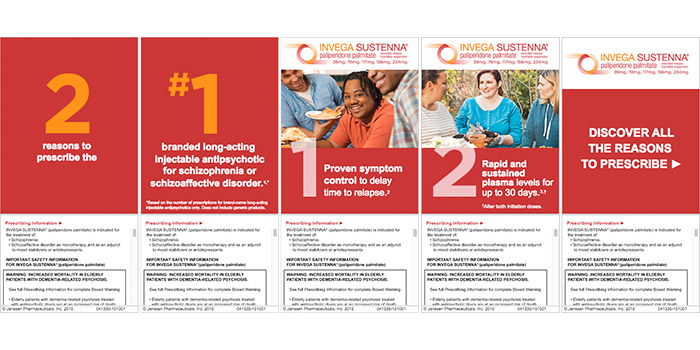
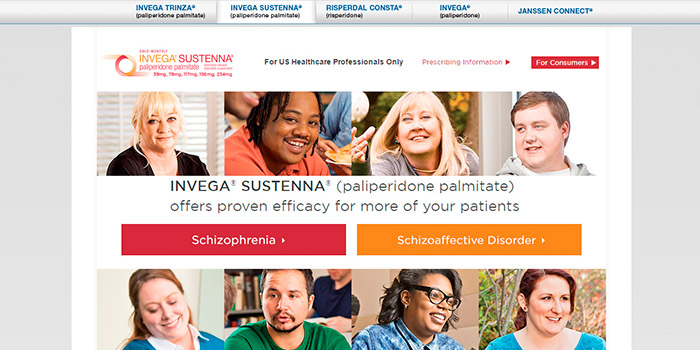
A click is a small act of trust. If the page doesn’t deliver what the banner promised, the brand pays for it. Deep-link to the content the ad names, and build the banner and the page as one brief.
Trafficking tomorrow?
Backup images that show the finished ad.
Packaged for every platform. Free.
JPGGIFMP4
Try it free
Pharmaceutical advertising examples: what to copy
Do get to the point. This unbranded AbbVie banner speaks to HCPs who treat women with endometriosis. It says who it’s for and why it matters in plain words.
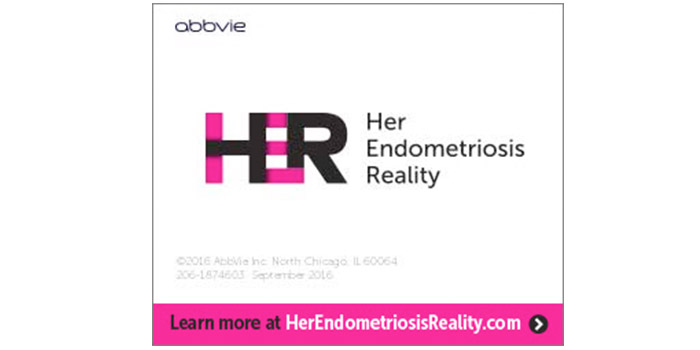
It uses very few assets. A bold color pairing and generous white space pull the eye down to the call to action. Simple creative is also easier to balance against safety copy.
Do use visuals that carry the message. This unbranded banner from the Humira campaign lets the images do part of the talking. Copy, imagery and animation lead to one value proposition, “Discover a possible treatment option,” and one call to action with an arrow.
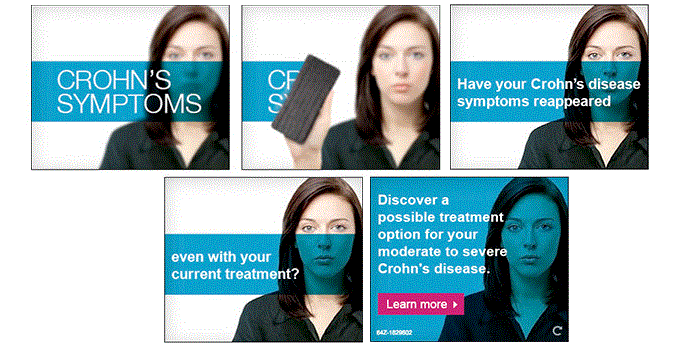
Note the small replay button. It lets people watch the animation again without reloading the page. Ask for one whenever an ad runs several frames. For more ideas, see our creative practices for pharma and healthcare banners and how to keep regulated banners from looking boring.
How to build a scrolling ISI in an HTML5 banner
The scrolling ISI is where pharma banners differ most from other display work. Here is the method our developers follow.

- Get the final approved ISI text first. Build from the approved copy, not from a draft that “won’t change much.”
- Reserve the ISI area in every size. Plan it in the layout from the start. Never squeeze it in after the animation is approved.
- Show it from the first frame. In a banner, screen time is part of prominence. Risk copy that appears late reads as less important.
- Set it as live HTML text. Live text stays sharp, stays searchable for reviewers and weighs less than an image of text.
- Auto-scroll slowly, and hand control to the user. Stop the scroll on hover or touch, and keep a visible scroll bar.
- Link to the full Prescribing Information and, where there is one, the Medication Guide. Give each link its own exit.
- Check the weight. Long ISI copy and web fonts add kilobytes. Our tips to reduce HTML5 banner size help when a size runs heavy.
Test every size at 100% zoom on a real phone and a desktop screen. Fine print that looks fine in a design file can be unreadable on a device.
Pharma digital ads by channel
Each channel adds its own rules on top of the FDA’s. Check them before production starts, not at trafficking.
| Channel | What to check |
|---|---|
| Google Ads | Google’s healthcare policy allows prescription drug ads from manufacturers in select locations only, and the manufacturer must be certified. |
| Ad servers and DSPs | Backup images. CM360 serves nothing when HTML5 can’t run and no backup exists. The Trade Desk requires one, and Amazon caps static backups at 40–50 KB. |
| HCP sites and point of care | Medical sites and EHR ad placements each publish their own specs. Get them before design starts. |
| Social | Expect the FDA’s new focus on sponsored content. Benefit claims still need risk information in the post itself. |
| No JavaScript, so no HTML5 ISI scroll. LiveIntent accepts only JPG, PNG or GIF. |
The backup image deserves extra care in pharma. It is the ad whenever HTML5 can’t run, so it needs the indication and the key risks, at a readable size. Our guide to HTML5 backup image requirements covers each platform. Our free tool turns an HTML5 banner ZIP into backup images, GIFs and MP4s for every size. For pharma, check the safety copy in each file before it goes to MLR.
Email needs its own static or GIF version, with the safety information built into the image. Our pharma HTML email overview explains the format.
MLR review checklist: keep pharma ads on schedule
MLR (medical, legal and regulatory) review is where pharma timelines slip. You can’t skip rounds, but you can make each one shorter.
- Lock the claims and the ISI before animation. A copy change after build costs more than one at storyboard.
- Submit a frame-by-frame storyboard with timings. Reviewers judge what people see, and for how long.
- Send every size, not one master. A 728×90 and a 300×600 present the ISI very differently.
- Include the backups, GIFs and email versions in the same round.
- Name versions clearly and log every change between rounds.
- Build the final files from the approved versions only, and keep a record of what was approved.
Big pharma campaigns run to dozens of sizes and versions. If your team can’t absorb that, here is what to ask a pharma banner production team before you hire. Or you can work with an HTML5 banner production company that builds scrolling ISI banners.
Frequently asked questions
What is fair balance in pharma advertising?
Fair balance means the risk information is comparable in depth and prominence to the benefit claims. FDA regulations name typography, layout, contrast and white space as factors. A banner that shouts the benefit and hides the risks fails it.
Does a pharma banner ad need ISI?
If the banner names the drug and what it treats, it needs risk information inside the ad and a link to the full Prescribing Information. In HTML5 banners that usually means a scrolling ISI panel.
Can a pharma ad show only the drug name?
Yes, as a reminder ad, which names the drug but does not say what it treats. Reminder ads are not allowed for drugs whose labeling carries a boxed warning.
Can you run prescription drug ads on Google?
Only in select locations. Google requires pharmaceutical manufacturers to be certified before their ads can serve.
What changed for pharma ads in 2025?
In September 2025 the FDA sent thousands of letters to drug companies and about 100 cease-and-desist letters. It also started rulemaking on the adequate provision loophole and said it uses AI tools to review ads.
Does the backup image need the safety information?
Treat it as a full ad, because it is the ad whenever HTML5 can’t run. The static frame should show the brand, the indication and the key risks, and it should go through MLR like every other size.
Sources
- 21 CFR 202.1: Prescription-drug advertisements (eCFR)
- Federal Register: FDA draft guidance on Internet/social media platforms with character space limitations (June 18, 2014)
- FDA: FDA Launches Crackdown on Deceptive Drug Advertising (September 9, 2025)
- HHS fact sheet: Reform of direct-to-consumer pharmaceutical advertisement policies
- Google Ads: Healthcare and medicines policy
- Google CM360: Create a display creative
- The Trade Desk Creative Specifications (PDF, March 2025)
- Amazon Ads technical guidelines
- LiveIntent ad specs
Looking for a banner production company?
Digitaland has produced HTML5 banners for agencies and brands since 2011. See how we work, or send us the brief and we take it from there.