
Updated May 2026 | Originally published 2019
Compare HTML5 banners with Digitaland 100% Free animation compare tool – Click here!
Pharma banner ads are some of the hardest display ads to build. You have all the normal challenges — file size limits, animation timing, multi-size layouts — plus a layer of FDA rules that don’t apply to any other industry. Get the creative wrong and your ad underperforms. Get the compliance wrong and you’re looking at warning letters, pulled campaigns, and legal headaches.
This guide covers how to build pharma banner ads that are both effective and compliant in 2026. We’ve produced thousands of healthcare and pharma banner ads for agencies, so this is based on real production experience — not theory.
How To Develop HTML Emails For The Pharmaceutical Market – FREE EBOOK
-
Why Pharma Banners Are Different
Every branded pharma banner ad that makes a product claim must include Important Safety Information (ISI). That’s the section with the drug’s risks, side effects, contraindications, and warnings. The FDA requires it by law, and there’s no getting around it.
Here’s what that means in practice: 30 to 50 percent of your banner space gets taken up by text that nobody wants to read. Your creative team has maybe half the canvas to work with compared to a regular banner ad. And you still need to make the ad look good, tell a clear story, and drive clicks.
On top of that, pharma ads go through a legal and regulatory review process that non-pharma ads don’t face. Every word, every image, every animation frame gets reviewed by medical, legal, and regulatory (MLR) teams before anything goes live. Changes that take minutes on a normal campaign can take weeks in pharma.
Choose high-impact ad formats for your banner ads

Healthcare Banners
The Three Types of Pharma Ads (and When You Need ISI)
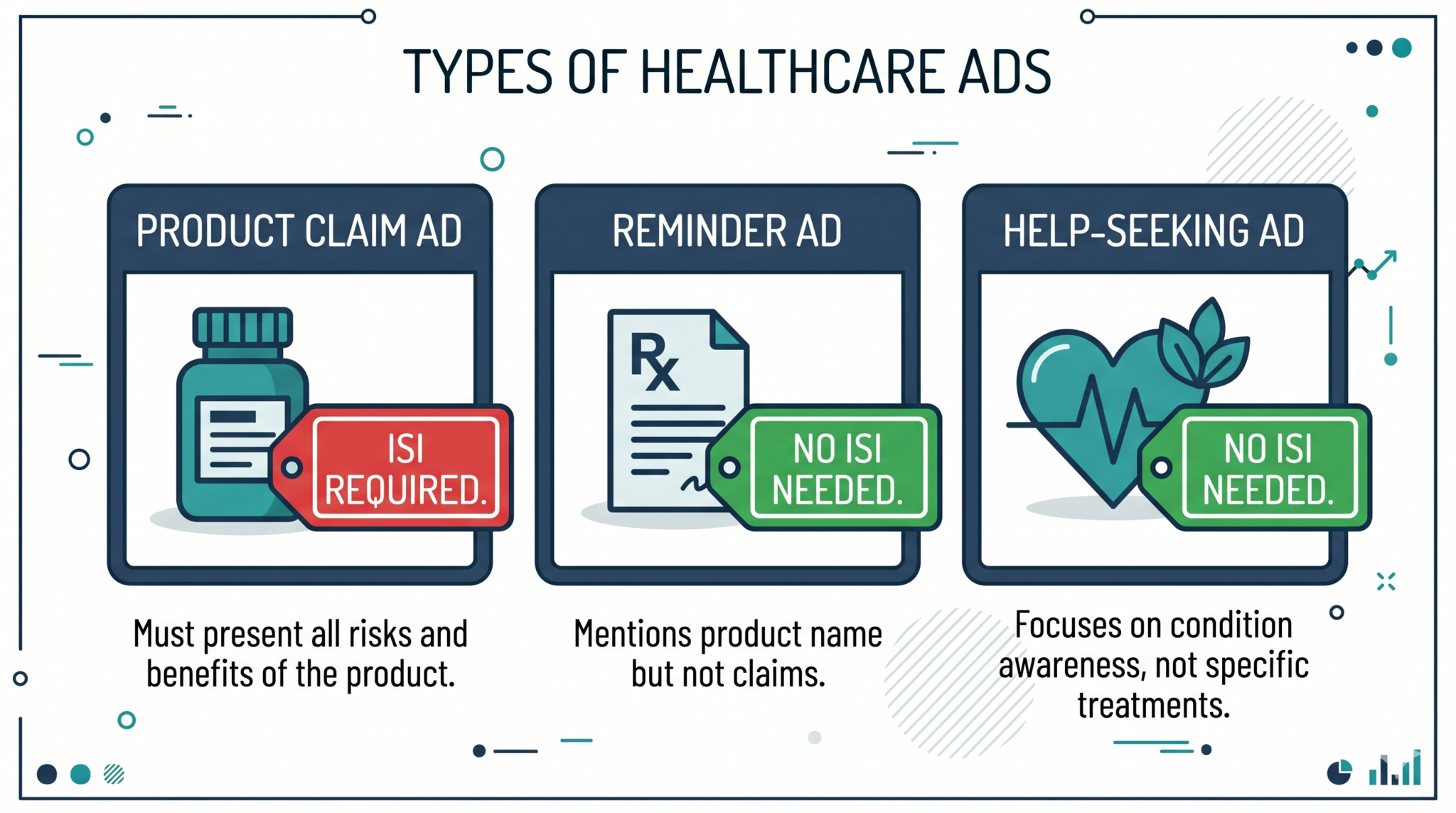
Not every pharma ad requires ISI. The FDA recognizes three types of pharmaceutical ads, and each has different rules:
Product Claim Ads mention the drug by name AND make claims about what it does. These require full ISI — all major risks, side effects, and a link or reference to complete prescribing information. This is what most branded pharma banner campaigns are.
Reminder Ads mention the drug name but make zero claims about what it does or what condition it treats. No ISI required. These are useful for brand awareness among people who already know the drug, but they’re limited in what they can say.
Help-Seeking Ads talk about a disease or condition but never mention a specific drug. No ISI required. These are used for disease awareness campaigns that point people toward “ask your doctor” messaging.
If your campaign is a product claim ad — and most branded campaigns are — you need ISI in the banner. Period.
-
Capture attention with animation

Pharma Banner
What Changed in 2025-2026: FDA Crackdown
If you haven’t updated your pharma ad process recently, you need to pay attention to this.
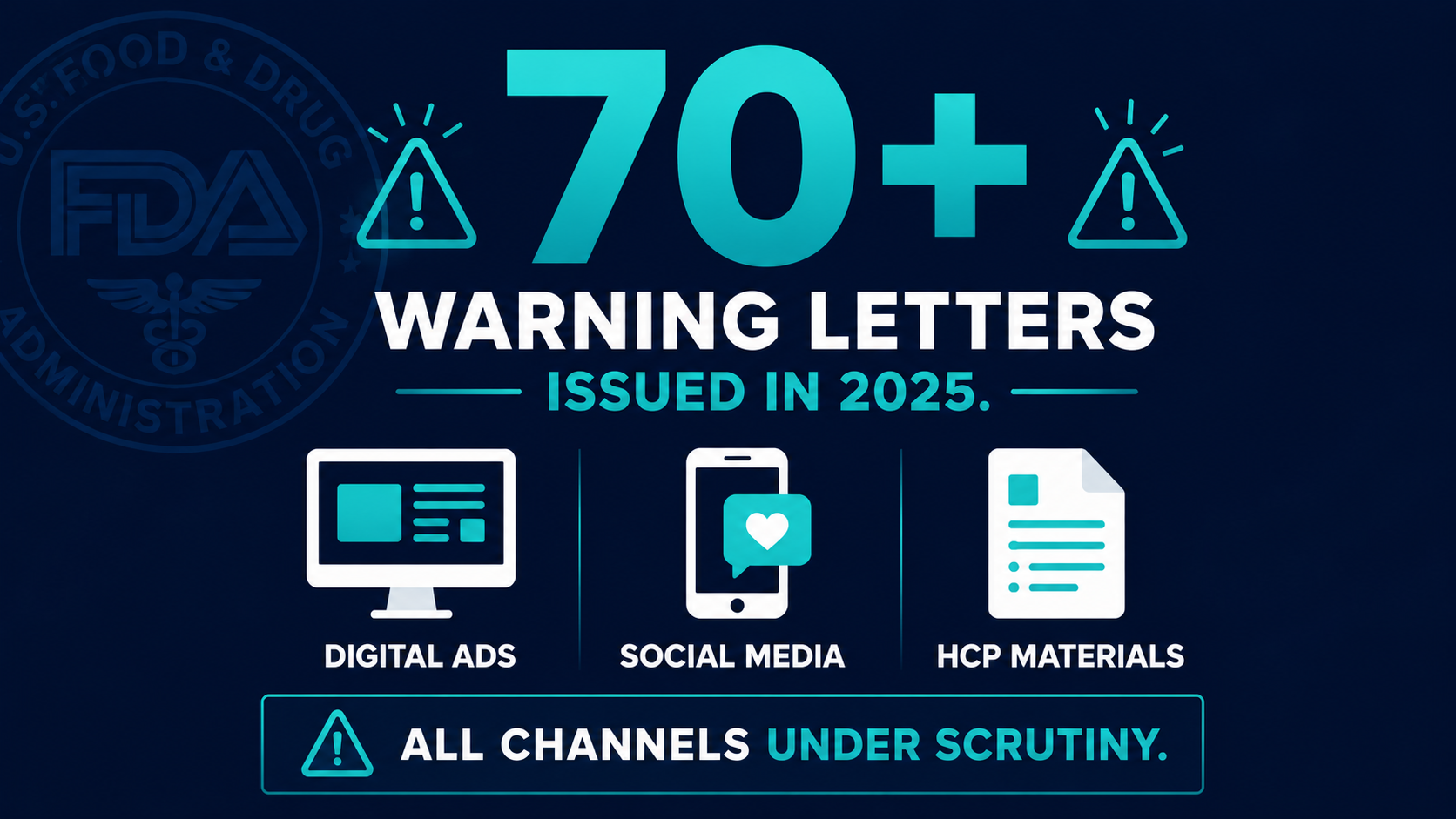
The FDA dramatically stepped up enforcement in 2025. They issued over 70 warning letters and untitled letters in a single year — the most aggressive enforcement action in recent memory. The crackdown wasn’t limited to TV ads. FDA went after digital ads, websites, social media posts, influencer content, and HCP-directed materials.
The FDA’s 2026 final rule added three new standards that are now enforceable:
Clarity — ISI language has to be understandable to the target audience. No hiding behind medical jargon that patients can’t follow.
Conspicuousness — Risk information can’t be buried, minimized, or tucked away. It has to be presented in a way that actually draws attention.
Neutrality — You can’t make the benefits look more important than the risks through design, size, color, or placement. The overall impression of the ad has to be balanced.
What does this mean for banner ads specifically? If your benefit headline is in 24px bold type and your ISI is in 8px gray text, that’s a problem. If your benefit animation runs for 10 seconds and your ISI frame gets 2 seconds, that’s a problem. The overall experience has to feel balanced.
-
Best Practices for Building Pharma Banner Ads
HTML5 digital display ads.
Credit: Once Daily Pharma
Make the ISI Work, Don’t Hide It
The ISI is going to be in your ad no matter what. Instead of treating it like a burden, build it into the design.
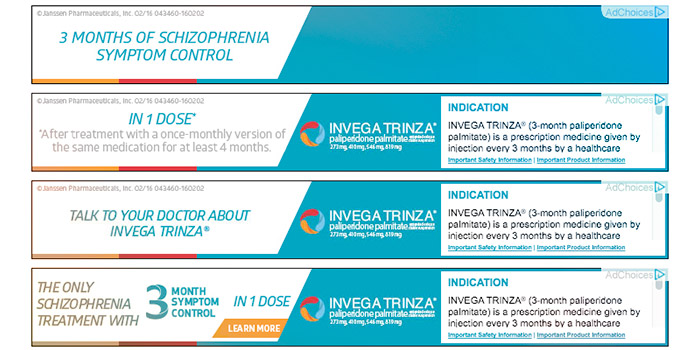
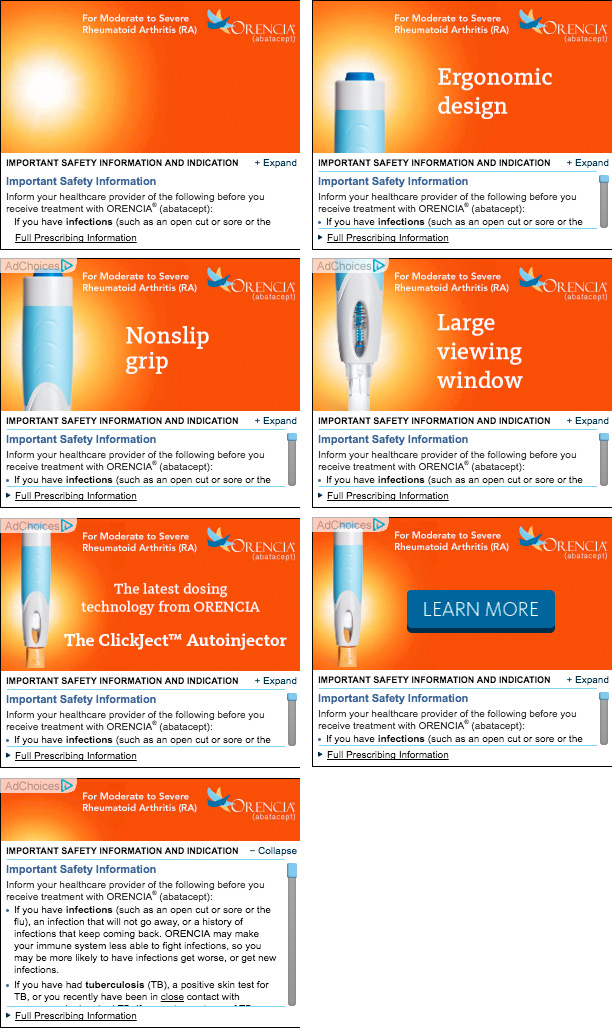
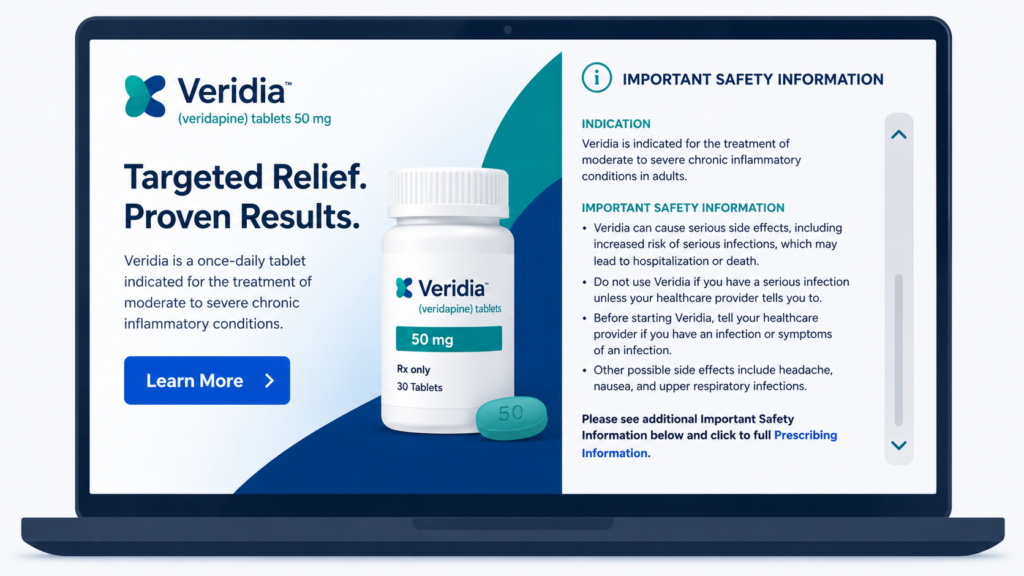
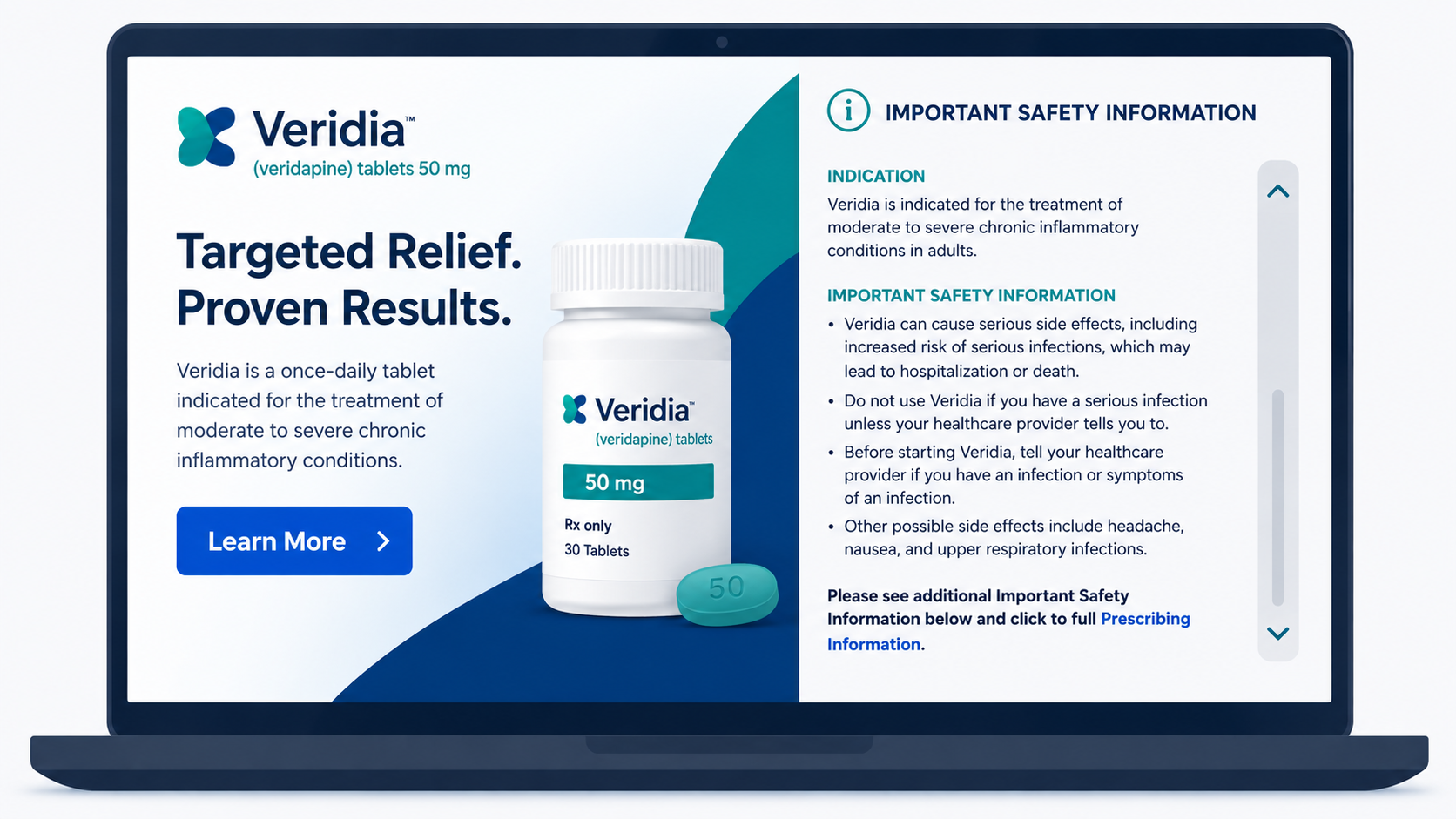
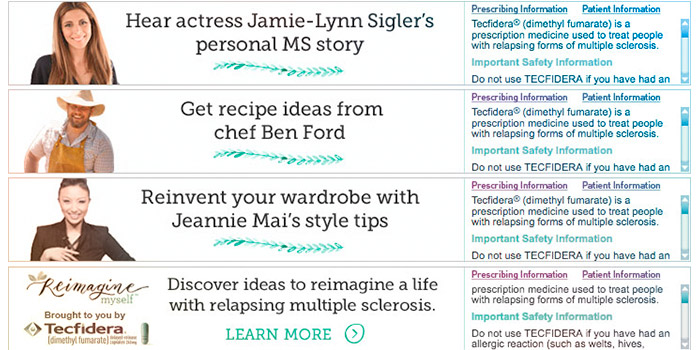
Add a scrollable ISI section within the banner. This lets you dedicate a defined area to ISI content without it taking over the entire ad. Use auto-scroll so users see the information moving, which signals that there’s more to read.
Style the ISI section with purpose. Add color to the scroll arrows. Use a contrasting background. Make the ISI heading readable. You don’t need it to be exciting — you need it to be clear and not look like an afterthought.
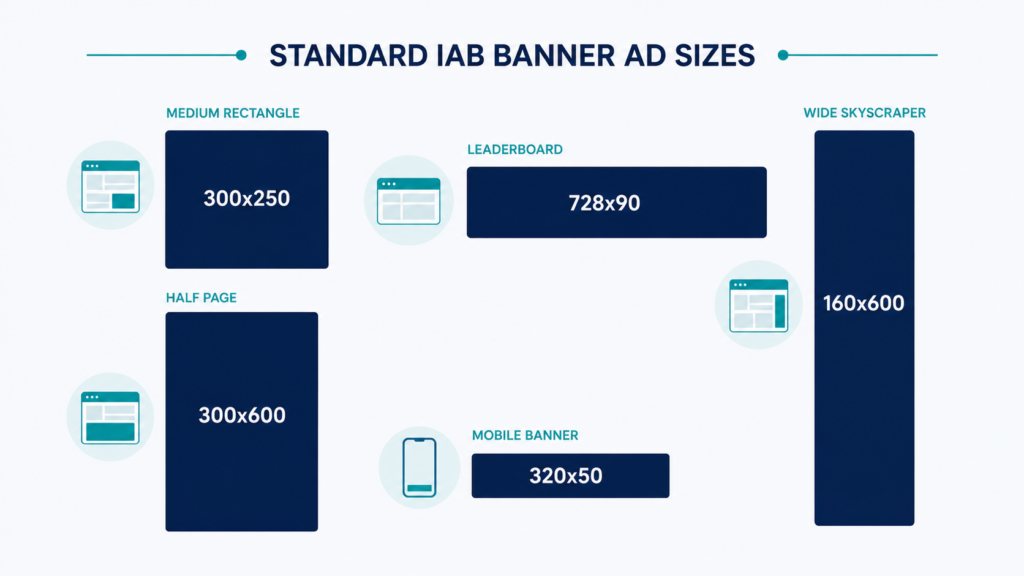
Make sure the ISI section works on every banner size. What fits in a 300×600 half page won’t fit in a 320×50 mobile banner. Each size needs its own ISI layout.
-
Include design elements in the ISI
Pharma Banner.
Credit: once daily pharma
-
Use the First Frames for Impact
In a typical pharma banner, the final frame holds the ISI. That means your first frames are where you need to grab attention and deliver your message.
Lead with the most compelling benefit or the patient outcome. Keep it short — one clear thought per frame. Use strong visuals that connect emotionally. Then transition to the ISI frame with a clear “Important Safety Information” header.
Don’t try to pack everything into the benefit frames. One strong message beats three weak ones fighting for attention in a small space.
Keep Copy Short and Clear
Pharma marketers often try to fit too many claims into a banner. Remember — a banner ad is not a detail aid. It’s not a brochure. It’s a tiny window that needs to do one thing: get someone interested enough to click.
One benefit statement. One call to action. One strong visual. That’s it for the benefit portion. Let the ISI handle the required disclosures. Let the landing page do the heavy selling.
Make the CTA Obvious
The call to action needs to stand out from both the benefit creative and the ISI section. Use a button color that contrasts with the background. Keep the CTA text simple — “Learn More” or “See Full Prescribing Information” work well.
Place the CTA where it’s visible on the final frame alongside the ISI. Viewers who read through the ISI and still want to learn more are your highest-intent audience — make it easy for them to take the next step.
Include a Replay Button
If your banner has multiple animated frames, add a replay button. Viewers may want to rewatch the benefit animation or reread the ISI. This is especially important for pharma because the information is dense and people don’t always catch everything on the first pass.
Make your call to action unmissable
HTML5 Banner Ads. Credit: Once Daily Pharma
Design for Mobile First
More than half of web traffic is on mobile in 2026. Your 320×50 mobile leaderboard is probably going to get more impressions than your 728×90 desktop leaderboard.
The problem: a 320×50 banner is tiny. Fitting a benefit message AND ISI into that space is nearly impossible. For mobile sizes, consider using expandable formats that open to a larger canvas when tapped, giving you room for both creative and ISI content.
If expandable isn’t an option, keep the mobile banner to a strong brand reminder with a “See ISI” link to the landing page. Talk to your legal team about what’s acceptable for your specific product — the rules around ISI presentation on small mobile formats aren’t always black and white.
Technical Production Tips for Pharma Banners
File Size Is Even Harder in Pharma
The standard 150KB file size limit applies to pharma banners just like any other display ad. But pharma banners often need more text content (ISI), more frames (benefit + ISI sequences), and sometimes scrolling functionality — all of which add weight. For general file size optimization techniques, check out our tips to reduce HTML5 banner size.
Optimize aggressively. Use CSS for backgrounds and gradients instead of images. Compress images with tools like TinyPNG before adding them to the build. Use system fonts or lightweight web fonts instead of embedding heavy font files. Minify your JavaScript and CSS.
ISI Scrolling Needs Careful QA
Auto-scrolling ISI sections need to work smoothly across all browsers and devices. Test the scroll speed — too fast and nobody can read it, too slow and it feels broken. Make sure the scroll works on both desktop (mouse wheel) and mobile (touch swipe).
Also test what happens when the ISI content is longer than expected. Your template needs to handle varying amounts of ISI text, because different products have different amounts of required safety information. Build flexibility into the ISI container.
Click Tags and Tracking in Pharma
Pharma campaigns often have stricter tracking requirements than other industries. Make sure your click tags work correctly on your ad server — Campaign Manager 360 (Enabler.exit()), Sizmek, Flashtalking, or whatever platform you’re using.
Some pharma campaigns also need exit tracking for the ISI link separately from the main CTA, so the agency can report how many people clicked through to full prescribing information versus the main landing page. Build this in from the start.
Legal Review-Friendly Deliverables
When you hand off pharma banners for MLR review, make it easy for the legal team. Provide screenshots of every frame as a PDF — the benefit frames, the ISI frame, and the final frame with CTA visible. Include the full ISI text as a separate document for reference.
Some pharma clients use specialized review platforms like Veeva Vault PromoMats. Ask your client what tool they use and make sure your deliverables are compatible.
Branded vs Unbranded Campaigns
Branded campaigns (product claim ads) are the heavy lift. Full ISI required, MLR review, FDA oversight, strict fair balance rules. These are the campaigns that need everything covered in this guide.
Unbranded campaigns (disease awareness / help-seeking ads) are simpler from a compliance standpoint. No ISI needed, no drug name mentioned, no specific product claims. The creative can focus entirely on the patient experience and driving awareness.
Many pharma marketing strategies use both: unbranded campaigns to build awareness about a condition, then branded campaigns to introduce the treatment to people who are already engaged. From a production standpoint, unbranded ads are built like normal display ads — the pharma-specific complexity only kicks in when the drug name and claims enter the picture.
What to Look for in a Pharma Banner Production Partner
Pharma banner production isn’t something you hand to a generalist studio. Here’s what matters:
Experience with ISI layouts. Have they built scrolling ISI sections before? Do they know how to handle varying ISI text lengths across different banner sizes? Can they show you examples?
Ad server expertise. Pharma campaigns run on specific ad servers with specific requirements. Your partner needs to know how to build compliant ads for Campaign Manager 360, Sizmek, or whatever platform your media agency uses.
Understanding of the review process. A good pharma production partner knows that the first build isn’t the final build. They’re prepared for multiple rounds of MLR feedback and know how to deliver review-friendly materials (frame captures, ISI text docs, annotated PDFs).
File size discipline. Hitting 150KB with an ISI-heavy pharma banner is harder than hitting it with a regular ad. Your partner needs to know how to optimize without cutting corners.
Fast turnaround on revisions. MLR review cycles can be unpredictable. When legal comes back with changes on a Friday afternoon that need to go live Monday, your production partner needs to move fast.
The Bottom Line
Pharma banner ads are hard. The FDA rules are real, enforcement is getting stricter, and the production requirements are more complex than standard display. But they’re not impossible — and when done right, they’re one of the most effective ways to reach patients and HCPs in a digital world.
The key is working with a production team that understands both the creative side and the compliance side. Great-looking pharma banners that get pulled by legal are a waste of money. Compliant banners that nobody notices are equally useless. The goal is both.
Want to go deeper? Download our free guide: How To Develop HTML Emails For The Pharmaceutical Market. And if you’re looking for creative inspiration beyond pharma, check out our post on gamified banner ads and how interactive rich media formats can take your healthcare campaigns further.
Digitaland is a digital production studio with deep experience in pharma and healthcare banner production. We’ve delivered thousands of compliant pharma ads for agencies across every major ad server. Get in touch to talk about your next pharma campaign.
4 Replies to this post
Good info, thanks! Any idea on the rules around auto-scrolling ISI and timing? I’ve always gone with starting scrolling ISI at the first repeat of the ad(15 seconds) and then running the ISI for 45 seconds keeping the entire ad under a minute of animation.
Also, how do you handle altering the scroll bar color in Firefox? Can you offer any codepens for colorizing the scroll bar?
Why is there a difference between regular ads and these pharma ads?
healthcare banners
This is very important. Because in fact it’s what can convince people of this important information
So I did not understand .. If I’m a beginner doctor, how am I supposed to market myself with pharma banner?